
Let’s do some basic Quality Engineering.
Bedbugs. Dirty bathrooms. Confusing screens at the self-order kiosk. A hole in the armpit of your brand-new shirt.
These are all the trademarks of a bad customer experience. All it takes are a series of bad Yelp or Google reviews to have your business end up in the trash bin of public opinion.
One of the best ways to boost your businesses reputation is to provide a high-quality customer experience, each and every time. There are quite a few engineering tools to do this such as checklists, scorecards, fishbone diagrams, etc. The American Society for Quality (ASQ) is the best resource for all these tools. This article will explore how to use score cards.
Score cards (or Balanced Score Cards) are effectively a rubric that leadership or engineering builds to assess the business process. This tool allows you to develop your own standards and scores, performance levels, and identify areas to improve your operation (1).
Score cards are directly related to customer experience because customers are scoring every interaction with you. If your customers have more positive interactions than negative, you are more likely to get repeat business. More negative interactions than positive, and out of business you go. 50% positive and 50% negative? You may be losing their repeat business anyway.
So how can we ensure that customers give your business good scores every time? By putting yourself in your customers shoes and evaluating your business the way a customer would. This is where the score card comes into play. We can do this by using the process below.
Step One: Identify all the steps in your business process.
List out every single step that your customer goes through when using your product. Go as deep as you need to ensure you capture the entire process. For a t-shirt company, you would need to see if your shirt rips or shrinks excessively after five wears or runs through the laundry. A pizza restaurant would need to assess not only the taste of their pizza, but the ease of ordering, the interaction with the staff, and whether or not the pizza makes the customer sick afterwards.
This is another way of saying that the entire interaction between you and the customer needs to be mapped out and studied quantitatively. For this article, we will use a hotel as our example.
Our hotel owner would document all the steps our customer has to take during the entire stay. This would include:
- Booking a hotel room.
- Check-In.
- Room inspection (including using the restroom).
- Watching TV and kicking up your feet.
- Taking a shower.
- Spending the night in your room.
- Getting breakfast.
- Check-Out.
Step Two: Assigning a scoring rubric for each step.
For each step, you will want to develop a rubric to assign a score against. Typically, the 0 to 4 scale will suffice. The criteria for each score will need to be defined in great detail. Within each step, map out every little event/hiccup that would contribute to each score. Leave no room for error. Let’s use step 3, room inspection, as an example:
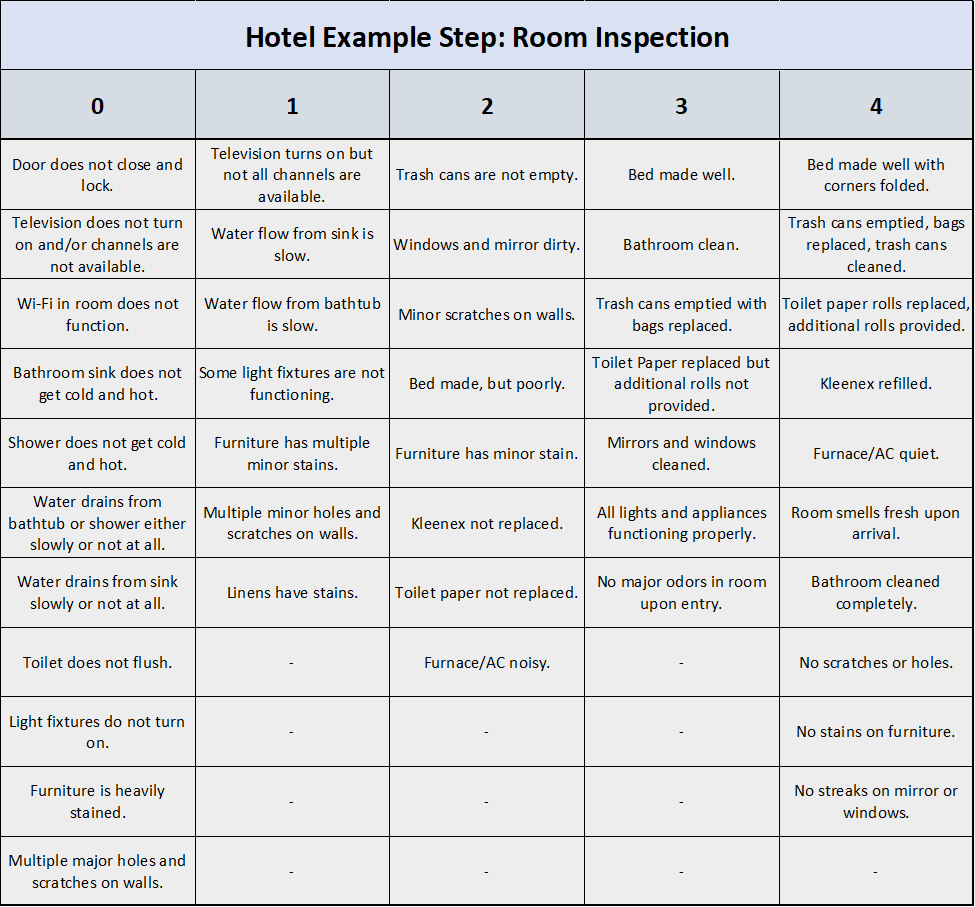
Do this for each step. You may end up having a booklet to read through when you do your evaluation, but the more items you can cover, the better. Once you build criteria for each step, make your overall table just to keep your thoughts straight. Below is an example for our hotel.
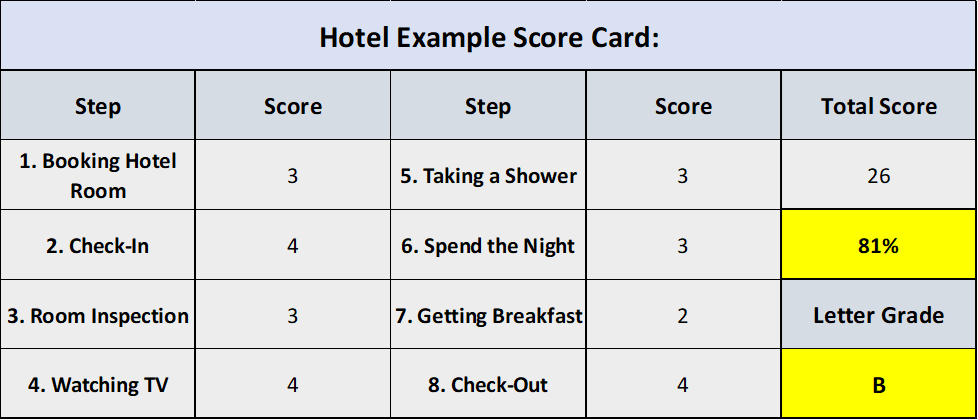
The final score would be to add up all the scores, and divide that by the total points available. Then you can use the following scale for assigning a letter grade:
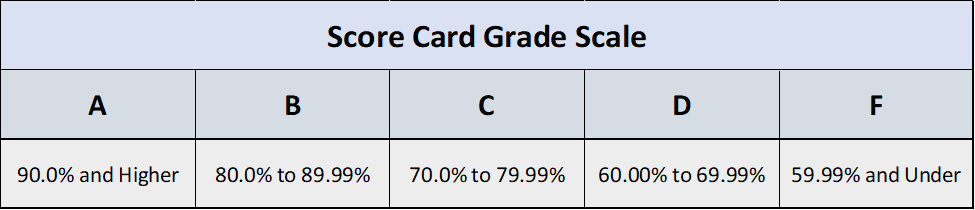
A score of 59.99% or under results in a failing grade. While that may seem harsh, it is important to remember that our ratio of positive to negative interactions can make or break repeat customers. That 50% good to 50% bad ratio tends to result in lost repeat customers.
Step Three: Have a customer (or two) proofread your rubric.
This is a bit unconventional, but this step is to prevent against tunnel vision. Your customers may see (or want) things that you or your team couldn’t think of even after multiple brainstorming sessions. Which means you might as well ask the people who pay your salaries. You will definitely want to provide a financial incentive for their participation.
Our hotel owner would seek out a couple guests (preferably loyalty members) to proofread the rubric and its criteria, along with providing their feedback. They may provide additional items to inspect, change up items in the rubric, or tell you that your initial brainstorms are right on the money.
Step Four: Have a member of leadership act as a customer and fill out score card.
Once your scorecards are developed, someone from your leadership team should go through the business process through the eyes of your customers, filling out the rubric as you go.
For our hotel example, this would include having the owner go through a stay at the hotel, going through all the steps (including staying the night).
Fill out the scorecard in its entirety, regardless of how much it hurts. Do not leave any detail out. If there is a possibility that one of your customers will see it, then you should document it.
This should be done by someone in leadership because they have the most at stake. This is not an insult to the rest of the team members. Leaders in the business are ultimately responsible for the survival of the business, so they should be the ones doing the first evaluation.
Step Five: Analyze the results with the group.
Grade the experience in the business process using the standards you built in the rubric, then break down the results with your team. From this review, determine action items needed to improve the scores in each process step, and assign a difficulty to each action item. Easy, medium, and hard difficulty ratings will suffice.
With our hotel, the owner found that the mirror was poorly cleaned, the bathroom door had paint chipping off the bottom, and the furnace was making a sharp grinding noise periodically which was noticed throughout the night.
Step Six: Implement Action Items rated “Easy”.
For all the resolutions/action items that you and your team rated “easy”, implement them at this step. This is to address some of the items that negatively impacted your score in the rubric prior to having your much tougher assessors, the customers, repeat this process. It also gets the team a couple quick wins and lays the groundwork for a quality driven mindset.
In our hotel, the poorly cleaned mirror would be rated as “Easy”. Upon discussion with your team, you identified that the housekeeper has only been on the job for two days, without much training on what right looks like. A detailed training session can be the resolution plan for this item.
Step Seven: Build Action Plan to address “Medium” and “Hard” items.
For each of these items, work with your team to determine how these resolutions/action items will be implemented. Then document and begin these implementation processes. It is okay if they are not completed in short order.
Using the hotel example, the paint chipping off the bathroom door would be rated as “medium” since we would need to procure some paint and tools. The furnace issue would be rated as “hard” because an HVAC technician would need to inspect the furnace, with the potential to be a costly repair.
Step Eight: Have a few customers navigate the business process and grade it with your score card.
This step requires some tough skin. Have a few customers go through the business process and grade your business with your rubric. It would be best to provide them a financial incentive. Pay them once you get the rubric filled out in full detail, especially if they are brutally honest with you.
Step Nine: Review the customers score card with your team.
Gather your team again to review the customers rubric with them, following the same process used previously. Add up their scores, develop resolution items to address the concerns listed, and assign difficulty ratings to those items.
At our hotel, all customers said that the beds were folded perfectly, but the trash cans themselves were dirty. Old sauce stains, cheese, etc. Two of the customers reported that the toilet paper rolls were replaced but additional rolls were not provided. Since the bed was folded perfectly and that was a top score, no resolution is needed. The missing additional toilet paper rolls is listed as “easy”, with the resolution of leaving an additional one roll of toilet paper in the bathroom.
Step Ten: Implement resolution items.
Build a plan to implement all the resolution items for the deficiencies identified by customers and leadership, complete with task owners and completion dates. This is to ensure accountability for getting these deficiencies fixed.
Wrapping This Up:
As you can see this process is much more intensive than scrolling through Google and Yelp reviews hoping not to find anything incriminating. This process of walking through your business process through the eyes of your customer allows you to mitigate potentially fatal customer complaints before they arise.
References:
[1] “What Is a Balanced Scorecard? BSC Quality Example | ASQ.” Asq.org, 2026, asq.org/quality-resources/balanced-scorecard?srsltid=AfmBOop10yivTJ-hU3MM915pNojJ5ETyfw8jMEj3bU_NI1T3bYkxyrp_. Accessed 26 Apr. 2026.
 Meridian Industrial Engineering
You must be logged in to post a comment.